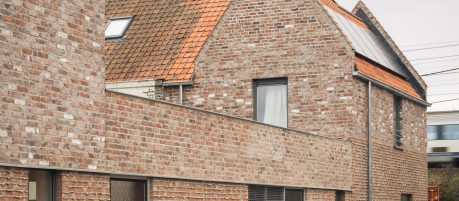
The street-facing block of a Belgian garden city development from the 1920s has been renovated and densified. The bricks from the old houses were reused in the process.
The eastern part of the Belgian city of Kortrijk was partially developed in the 1920s, modeled on English garden cities – with green courtyards, winding avenues, and small kitchen gardens for self-sufficiency. As visionary as the original concept was, the renovation of one of these blocks is equally far-seeing.
Of the original fifty-six terraced houses, around a third are still owned by a public housing company. However, they were in such a state of disrepair that the provider had them demolished and replaced with new structures. The term “demolition” isn’t entirely accurate, as Ghent-based MAKER architecten took account of social, sustainable, and circular economy aspects in the densification project.
The houses were carefully dismantled, and as many roof and wall tiles as possible were preserved, sorted, and reused. The lime mortar used allowed for relatively easy disassembly, cleaning, and reutilization. In total, 1,100 square meters of old roof tiles could be removed and repurposed to cover the new pitched roofs.
The wall bricks, in turn, were reused as façade cladding or, if damaged or broken, as filling for the gabions that stand along the property lines. To ensure this cycle can continue even in the event of future demolition, a lime-cement mortar, a so-called bastard mortar, was applied. To give the new façade surfaces a slightly rough patina, the architects decided not to brush off the joint mortar, but rather to allow it to ooze out plastically between the bricks. In the façades, the mixture of old and new bricks tells the story of the site and its careful transformation.