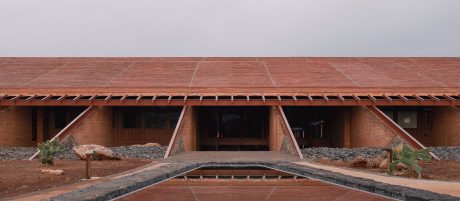
Inspired by the site, the architects designed a new brick and steel structure that blurs the lines between building and landscape.
Clase Azul, made from organically grown blue agave, is considered one of the world’s finest tequilas. Founded in 1998, the distillery is located in the heart of Mexico’s volcanic belt – the very landscape where the agave thrives. The architectural firm ATELIER ARS was commissioned to develop a new, standalone industrial building near the existing office structure – with storage facilities, offices, a bottling plant, a laboratory, and other functional spaces.
Drawing inspiration from the color of the iron-rich volcanic soil with its warm, earthy tones and the open landscape with its expansive views, the architects designed a building that appears to grow organically from the ground and, through a system of sloping, tiled roofs, literally merges with the landscape. For the construction, they used regionally produced, handcrafted bricks, as well as natural stone salvaged from the excavated material for the base and floor. They combined regional building techniques, such as Catalan vaulting, load-bearing brick walls, and buttresses, with typical industrial construction forms.
The building’s most striking feature is the sawtooth roof covered with clay tiles – a modern steel structure that allows for large spans, literally anchors the building to the ground, and, through its color alone, blurs the boundary between architecture and landscape. Beneath these large sawtooth roofs lie the American oak whiskey barrels in which the double-distilled and triple-filtered tequila matures, acquiring its characteristic oak and vanilla notes as well as earthy aromas. In its statement, the jury emphasizes that the project is distinguished by its powerful synthesis of structure, materiality, and landscape, and that the very ability to be both infrastructure and landscape, monumental and modest, underscores the project’s exceptional relevance.