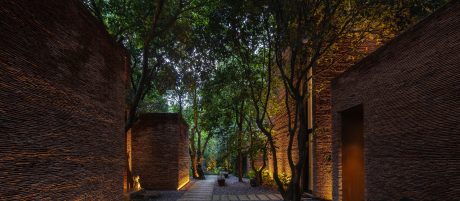
The towers and walls of the Đạo Mẫu Museum consist entirely of old roof tiles – collected and pieced together to intertwine nature, religion, and history.
The Đạo Mẫu Museum is located in the Sóc Sơn district on the outskirts of Hanoi. Together with its adjacent garden and temple, it becomes a mysterious sacred space where nature, religion, and culture interweave in a unique way. It is a place that brings to life what Đạo Mẫu stands for: a religious practice that venerates mother goddesses as the embodiment of nature, cosmos, and human life.
The museum and temple are situated on the 5,000-square-meter property of folk artist Xuân Hinh. The actor, comedian, and singer of the traditional Vietnamese folk theater Chèo is the museum’s patron and driving force. As a Chèo artist, he is deeply rooted in Vietnamese folk culture, which considers Đạo Mẫu a central component. Housed in Xuân Hinh’s former residence, the museum features a covered walkway that connects the existing and new buildings with the temple. The interplay of light, shadow, and transitions alludes to the traditions of mother goddess temples.
In a fifty-year-old orchard, a path leads through a garden dotted with lychee trees, flanked by a long wall and five twelve-meter-high towers, to the main house. Broken roof tiles are scattered throughout the garden. For the walls of the complex, arb architects exclusively used reclaimed roof tiles – a total of six million pieces collected over three years. These tiles came from surrounding villages, from houses that had fallen victim to urban sprawl, and exemplify both sustainability and cultural continuity. The clay tiles were bonded together with mortar and steel reinforcement to create a load-bearing structure. Their varying color nuances and the application of three different laying techniques produce a vibrant, almost textile-like surface: the walls appear woven, not bricked.