A subsidized housing project demonstrates how pragmatic planning can generate unexpected spatial qualities – and how brickwork can be both aesthetically pleasing and climate-regulating.
The Spanish architects Peris + Toral are known for setting new standards in social housing with their residential buildings, combining spatial innovations with sustainable construction materials. This also applies to one of their more recent projects, the Social Atrium, a residential block with fifty-four apartments in El Besòs, a district of Barcelona. Together with the engineering firm L3J, they developed a structure comprised of a lower building with four floors and a ten-story tower. The exterior is characterized by horizontal concrete bands at ceiling level and light-colored brick walls, which are both solid and partially perforated.
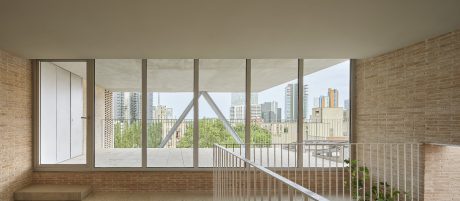
As cubic and austere as the building appears at first glance, the façade is dynamic with its irregularly staggered windows and a tower cantilevered at the junction of the two volumes. The heart of the residential building is a bioclimatic atrium that extends to the roof, providing natural light and ventilation to the public areas. Air circulates freely throughout the structure, regulating temperature according to the season.
Residents also have access to a shared terrace on the fifth floor and a viewing platform on the tenth. The light color and materiality of the handmade bricks lend a pleasantly warm atmosphere not only to the façade but also to the interiors. Inside and out, the closed brick walls are punctuated by brick lattices. This interplay of various brick textures echoes a motif in Catalan architecture found in both traditional and contemporary buildings. The structure is designed so that the load-bearing elements are located within the partition walls between the apartments, allowing for flexible floor plans. Cross-ventilation of the living areas is guaranteed in all possible configurations.